The Last of Us Season 3 is Set to Show an Unexpected ‘Hero’ After Shocking Finale Cliffhanger

Warning. Major spoilers for The Last of Us Season 2 and The Last of Us: Part II game. The Last of Us Season 2 came to an end, and the ending sets up a very different Season 3. But before that, the show gave us more of Ellie’s revenge quest, more heartbreaking deaths, and another confrontation with Abby that ended in quite a cliffhanger, one that might not end up being resolved as soon as fans might want.
The Last of Us Season 2 delivered on the game’s biggest twist early on, with the show killing off Pedro Pascal’s Joel in Episode 2 and setting up Ellie’s journey of revenge. There was very little of Abby—the woman who killed Joel in revenge for him killing her father to save Ellie—the rest of the season, but there was always a feeling that we’d return to her sooner or later.


Related: Who dies in The Last of Us Season 2?
In the season finale, that’s exactly what happens. After Ellie has killed Nora, Owen, and Mel, the latter by accident, only Abby is left. And yet, Dina is injured, Tommy and Jesse have come to bring them back to Jackson, and it seems like Ellie is willing to let it go. Or at least, try. That is, until Abby finds Ellie, and the episode ends with Abby pointing her gun at her and a gunshot we only hear, not see. The show then flashes back to Seattle, Day One, once again, this time from Abby’s perspective.
But what does this mean for Ellie? Does Ellie die in The Last of Us game? And what’s next for Abby and the show?
Does Ellie die in The Last of Us Game?
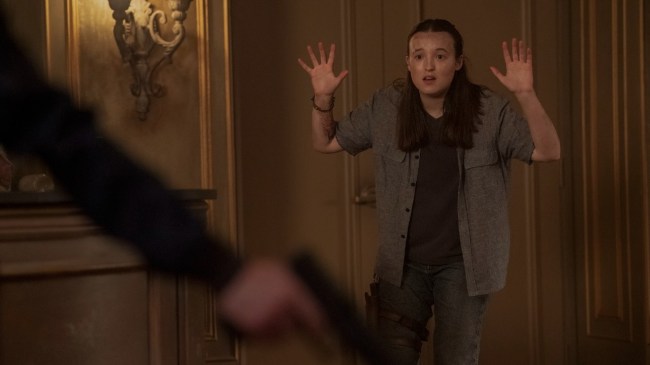
Ellie does not die in The Last of Us game. She survives this confrontation with Abby, who kills Jesse, as we already saw in the show’s Season 2 finale, and gravely injures Tommy. Instead, after a confrontation, Abby lets Ellie go because Lev, a character we have yet to meet in the show, but who will show up as we see Abby’s side of the story, intervenes.
“I let you live and you wasted it,” Abby tells Ellie in the last few moments of Season 2. We don’t see how their confrontation goes afterwards, and we likely won’t see the resolution for a while, considering the show seems to be making the same storytelling choice the game did. As we jump to Abby’s POV starting with the first day in Seattle, Season 3 is perfectly set up to be Abby’s story, at least for the most part.
The game does pretty much the same thing, jumping to Abby’s side of the story in an effort to make you sympathize with her. In fact, the game takes it a step further, making you play as Abby as she bonds with two Seraphites, Yara and Lev. This all leads to this very confrontation with Ellie, where Ellie is ready to give up on her revenge, and finds that she cannot, as Abby is once again there, a mirror to her worst actions.
Where does the show go from here? The Last of Us showrunners Craig Mazin and Neil Druckmann said in a press conference that Season 3 now meant to be Abby’s story. “There is another side to this story that we have yet to really delve into,” Craig Mazin said during the press conference. “There’s no question that Abby is the hero of her story. Kaitlyn Dever is the hero of a story always, you know? I mean, if you have Kaitlyn Dever, you use a Kaitlyn Dever.”
And that means that Season 3 might give us the things we missed out—not just with Abby, but with her crew, perhaps taking us once again to the same cliffhanger. “There’s no way to complete this narrative in a third season,” Mazin said. “Hopefully, we’ll earn our keep enough to come back and finish it in a fourth. That’s the most likely outcome.”
The show might not be giving us the answer anytime soon, but at least now you know. Ellie survives. We might have to wait a while to see it on screen.